

Retail expansion is a major milestone for any food or beverage brand.
More stores mean greater visibility, broader consumer reach, and new commercial opportunities. But as distribution grows, so does operational complexity, and the importance of effective food regulatory compliance.
Entering a new retail market is not simply about securing shelf space. It also requires confidence that product labeling, supplier controls, documentation, and applicable regulatory requirements have been properly addressed.
Retail growth should be supported by regulatory readiness, not followed by it.
Retail Growth Example: Expansion and Regulatory Risk
In June 2026, Frankie’s Organic Snacks announced a major U.S. retail expansion, introducing four avocado oil Puffcorn varieties into more than 500 Target stores nationwide. The expansion brought its reported U.S. retail footprint to over 1,500 locations, marking an important commercial milestone for the growing snack brand.
Just two months later, the company faced a different challenge.
In August 2026, Frankie’s Organic voluntarily recalled 94 cases of its Plant-Based Vegan Cheddar Puffs because the product potentially contained undeclared milk, a major food allergen.
According to the company's recall announcement published by the FDA, the undeclared milk originated from an ingredient provided by its seasoning supplier. The affected products had reached retailers in Washington, Florida, and South Carolina, and the company worked with three distribution centers to remove remaining inventory.
These events raise an important question for any food brand expanding its distribution:
Are your regulatory processes growing with your business?
Retail expansion does not necessarily introduce new FDA requirements, but broader distribution can increase the operational consequences of unresolved compliance issues.
For food manufacturers and growing FMCG brands, several areas require attention:
FDA food labeling requirements and Nutrition Facts
Food allergen labeling and ingredient declarations
Supplier verification and ingredient controls
Food safety compliance and documentation
Packaging accuracy and product claims
Retailer and distributor requirements
Importer responsibilities and FSVP, where applicable
These responsibilities are interconnected. A problem originating in one area can affect other stages of production, packaging, and distribution.
The timing and reliability of these regulatory checks can make a significant difference.
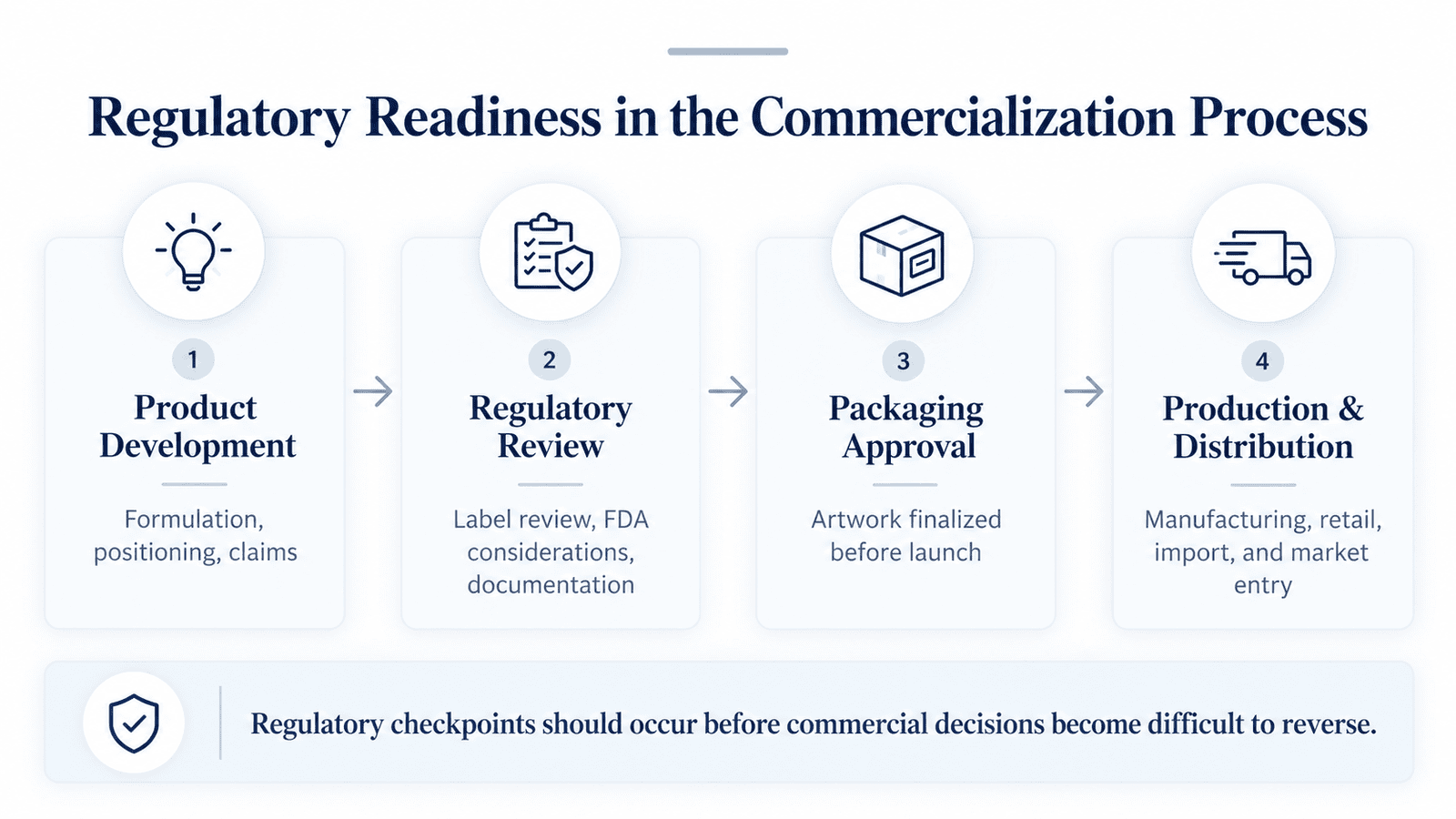
A labeling or compliance issue identified while packaging artwork is still being finalized can often be addressed while the business retains flexibility.
An incorrect ingredient declaration, missing allergen statement, or unsupported product claim may be corrected before packaging is printed and products are manufactured.
The same issue discovered after production or distribution has begun can be considerably more difficult to manage.
Depending on the circumstances, corrective action may require packaging revisions, inventory holds, product relabeling, coordination with retailers and distributors, or a product recall.
The regulatory obligation may remain the same. The cost of overlooking it may not.
The Frankie’s Organic recall highlights another important consideration: labeling accuracy depends on reliable information throughout the supply chain.
According to the FDA-published announcement, the undeclared milk originated from a seasoning supplier's ingredient. The incident illustrates how supplier-related ingredient issues can affect finished products and require corrective action after distribution.
Accurate food allergen labeling therefore depends on more than reviewing what appears on the package. It also requires appropriate ingredient controls, supplier communication, and procedures for identifying relevant changes.
This is why Food Label Review should not be treated simply as a final packaging check.
Used strategically, it can serve as an important regulatory checkpoint during product development and commercialization. Reviews should also be reconsidered when formulations, ingredients, suppliers, or packaging information change.
Professional regulatory review cannot guarantee compliance or eliminate every risk. Nor does a label review replace applicable food safety or supplier verification obligations.
However, early evaluation can help identify potential problems before commercial decisions become more difficult and expensive to reverse.
Compliance Should Be Part of the Growth Strategy
Growing food companies routinely invest in manufacturing capacity, logistics, marketing, retail relationships, and distribution.
Regulatory readiness deserves the same attention.
Rather than approaching compliance as a final obstacle before launch, businesses should integrate regulatory checkpoints into their existing product development and commercialization processes.
This includes evaluating FDA food labeling requirements before packaging approval and verifying ingredient and supplier information. Businesses should also review product claims, maintain appropriate compliance documentation, and reassess regulatory obligations when operations change.
For companies entering the U.S. market, applicable import requirements and importer responsibilities should also be evaluated before shipments are arranged.
The objective is not to slow commercial growth. It is to reduce the likelihood that preventable compliance problems will disrupt it.
FC SOLS supports food manufacturers, importers, international companies, and growing FMCG brands through:
For companies launching new products, entering retail chains, expanding distribution, or introducing products into the United States, regulatory preparation should begin before the next stage of commercialization.
Retail expansion creates opportunity. Regulatory readiness helps protect the progress made to reach that opportunity.
Planning Your Next Stage of U.S. Growth?
FC SOLS can help your business evaluate FDA labeling, regulatory compliance, FSVP, and market-entry requirements before your next commercial milestone